Categories
Garage Door Maintenance, Safety & Hurricane Protection

How to Check Whether Your Garage Door Is Hurricane Rated in Florida

Knowing whether your garage door is hurricane rated in Florida is not something to leave to guesswork. When a tropical storm watch goes up and a Jacksonville homeowner finally inspects the garage, discovering a faded label, a loose reinforcement strut, and missing installation paperwork is the worst-case scenario. That is the wrong time to find out that “hurricane ready” was only an assumption.

A1A Overhead Door Company helps homeowners identify, maintain, repair, and replace garage doors across Jacksonville and nearby communities.

We are a family-owned, non-franchised company founded in 2000, and we will be direct: a heavy-looking door, a recent installation, or a wind sticker by itself does not prove the door is approved for your house.
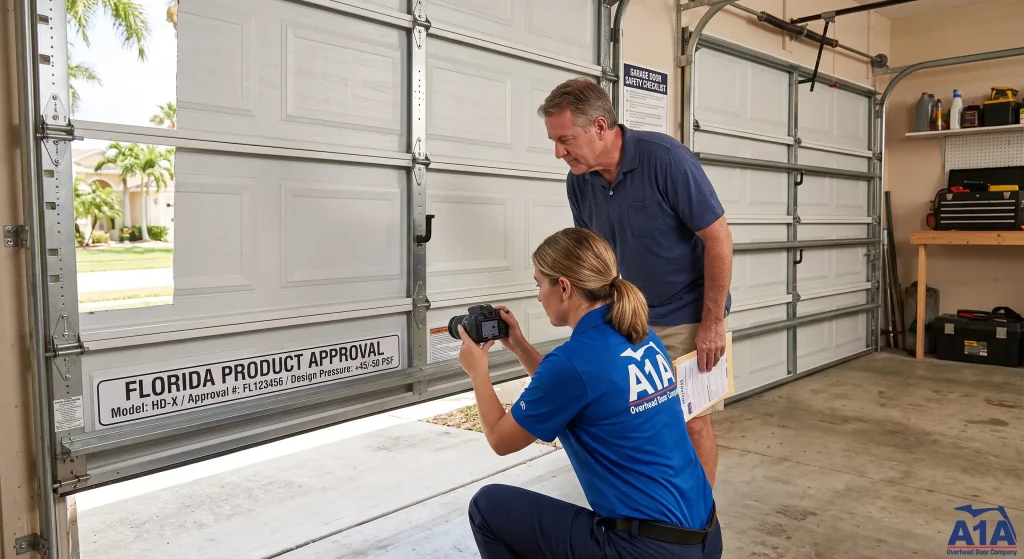
How to Check If a Garage Door Is Hurricane Rated in Florida

Is the Door Actually Approved for Your Florida Opening?

A real check connects the exact door to an active approval, the required pressures at the property, the approved installation instructions, and the condition of the complete assembly. Here is how to do that before the forecast turns ugly.

Florida does not give every garage door one identical statewide hurricane rating. The right door depends on the building location, opening size, exposure, building geometry, required positive and negative design pressures, and whether wind-borne debris protection applies.

Florida law establishes a statewide product evaluation and approval system coordinated with the Florida Building Code. It also says a product marketed as hurricane, windstorm, or wind-borne-debris protection must have the required approval, and an approved product must be used consistently with the conditions of that approval.

That last part matters. An approval for one model, width, height, pressure range, track setup, or anchoring condition does not automatically cover another.

Decision: Start With Identity, Not Appearance

Stand inside the garage with the door fully closed and the opener disconnected only if the door is operating normally. Look for a permanent manufacturer label on an end stile, interior section, track area, or another location identified by the manufacturer.

Photograph every label before trying to clean it. Capture the manufacturer, model or series, serial number, door size, manufacturing date, design-pressure information, and any Florida Product Approval number that appears.

Do not call a door rated because it has horizontal struts. Reinforcement is part of some approved assemblies, but similar-looking struts can appear on doors that have different tested capacities or were altered after installation.

Decision: Treat Missing Information as Unverified

If the label is unreadable or missing, check the original permit packet, invoice, owner’s manual, installation drawings, and product-approval documents. The building department that issued the permit may have records, but availability and detail vary.

No matching label or documentation means the rating is not confirmed. It does not prove the door is weak, but it does mean you should not advertise, insure, sell, or rely on it as a hurricane-rated assembly without further verification.

Does the Approval Match the Exact Door You Own?

Florida maintains an online Product Approval search where homeowners and contractors can look up approved products. A number beginning with “FL” is useful only when the record matches the installed product and remains appropriate for the current code and application.

Verification: Open the Product Record

Enter the full approval number in the Florida Product Approval search. Confirm the manufacturer, product category, subcategory, model or series, approval status, and the code edition tied to the record.

Then open the evaluation report and installation instructions attached to the approval. Those documents control the permitted sizes, design pressures, glass options, reinforcement, track, jamb attachment, fasteners, spacing, and other conditions.

A product page or sales brochure is not a substitute for the approval documents. Marketing names can cover several constructions, while an approval may cover only specific configurations.

Verification: Match Size and Design Pressures

Measure the opening width and height, but do not assume a close size is good enough. Compare the installed door with the exact size limits or tables in the approval.

Look for both positive and negative design pressures. Wind pushes inward on one surface and can pull outward on another, so passing one pressure value does not establish compliance with both requirements.

The required pressures for a home are site-specific calculations, not a nickname such as “hurricane door.” A building official, design professional, permit record, or qualified door professional can help identify the values that apply to the opening.

Verification: Check Impact Protection Separately

Wind-pressure resistance and impact resistance are related but not interchangeable. A door may resist a specified pressure without being approved for large-missile impact, or the opening may rely on a separate approved protective system.

If the home is in an area where wind-borne debris requirements apply, verify exactly how the opening is protected. Decorative glass, replacement windows, or later panel changes must also remain within the approval conditions.

Was the Door Installed as the Approval Requires?

A valid approval number does not rescue an incomplete installation. The door, tracks, brackets, fasteners, reinforcement, jambs, and supporting structure work as one assembly.

Inspection: Compare the Visible Hardware

With the door closed, compare the visible reinforcement and track arrangement with the approved drawings. Look for missing struts, loose brackets, pulled fasteners, bent track, corrosion, cracked hinges, damaged panels, or anchors that do not match the documented pattern.

Do not remove fasteners or covers to investigate. Do not add lumber, angle iron, screws, or homemade braces unless they are part of an approved retrofit designed for that exact door and opening.

A field modification can change how loads travel through the assembly. If the approval calls for removable storm posts or braces, locate the complete hardware and the manufacturer’s instructions long before a storm.

Safety Stop: Know When Not to Test

Should you lift a door with a broken spring, loose cable, crooked section, or unusual weight to find a label? No. Stop using the door.

Springs and cables hold serious stored energy, and a crooked or heavy door can fall or leave the tracks. Keep people and vehicles clear and request garage door repair rather than turning a documentation check into an injury.

Is the Door Still Storm Ready Today?

An approved installation can deteriorate. Coastal air, repeated cycles, vehicle contact, water intrusion, loose hardware, and unapproved repairs can reduce confidence in the assembly.

The National Weather Service says hurricane winds can destroy buildings and turn signs, roofing material, and outdoor items into flying missiles. That is why the door needs both pressure resistance and a clear area outside it.

Condition Check: Inspect Before Hurricane Season

Operate the door through one normal cycle and listen for scraping, popping, or strain. Watch from a safe position for shaking, gaps, track movement, uneven travel, or a section that bows more than expected.

Check the bottom seal and perimeter weatherstripping for obvious gaps, but do not confuse weather sealing with structural rating. Water resistance, wind pressure, and impact performance are different questions.

Schedule residential garage door service while there is time to obtain parts and review documents. A storm watch is not a maintenance appointment.

Storm Action: Follow the Approved Instructions

If the approved system uses storm braces, install them exactly as the manufacturer directs before dangerous conditions arrive. Confirm that vehicles, storage, and floor coatings do not block the brace attachment points.

Close the door completely and keep it closed during the storm. Move grills, patio furniture, tools, and loose material indoors because wind-driven debris can strike the largest opening on the house.

Review A1A’s broader garage door hurricane-season checklist for condition and preparation reminders. Follow evacuation orders and official weather guidance rather than staying behind to monitor the garage.

After the Storm: Do Not Force Damage

The National Weather Service advises checking for structural damage and other hazards after a hurricane and returning only when officials say it is safe. From a safe location, look for bent tracks, displaced panels, broken glass, water damage, loose wiring, and a door that no longer sits square.

Do not run the opener repeatedly against a jammed door. If the door is crooked, unusually heavy, off track, or has damaged springs or cables: No. Stop using the door.

Should You Repair, Retrofit, or Replace It?

The honest answer depends on what can be documented and what the approval permits. There is no responsible shortcut that turns every existing garage door into a compliant hurricane assembly.

Decision: Maintain a Verified Assembly

Maintenance makes sense when the exact door and approval match the opening, the required pressures are satisfied, the installation follows the drawings, and wear can be corrected without changing the approved configuration. Keep the product record, permit documents, invoice, and current photos together.

Decision: Consider an Engineered Retrofit

A retrofit may be reasonable when an approved reinforcement package exists for the exact model and opening or when a qualified design professional specifies a compliant solution accepted by the local authority. Random bracing copied from a video is not an engineered retrofit.

Decision: Replace an Unverifiable or Inadequate Door

Replacement deserves consideration when the door cannot be identified, the approval does not cover its size or required pressures, impact protection is required but absent, major components are damaged, or alterations no longer match the approved assembly.

A1A installs hurricane-compliant options and works with C.H.I. and Amarr garage doors, along with Genie and LiftMaster openers. Start with the opening and required performance, then choose the appearance and operator, not the other way around.

Our garage door installation service can help you compare appropriate options without pretending every home needs the same product.

What Will a Hurricane-Rated Garage Door Cost?

There is no single honest price range for a hurricane rated garage door Florida homeowners can apply to every opening. A single-car opening and a wide, reinforced door with glazing, impact requirements, framing work, and permitting are not comparable jobs, so a broad national number would create false confidence.

Cost Factors: What Changes the Quote

Door width and height, required positive and negative pressures, impact requirements, panel construction, insulation, glazing, finish, reinforcement, track configuration, attachment conditions, framing repairs, removal, labor, and permit needs all affect the job. Availability and the amount of correction needed at the opening also matter.

The useful comparison is not the lowest door-only price. Ask each contractor to identify the exact product approval, configuration, included hardware, installation scope, and exclusions in writing.

For a property-specific review, contact A1A Overhead Door Company or call 904-821-8463. We are based at 1520 Emma Ln, Neptune Beach, FL 32266, and serve Jacksonville plus communities in Duval, Nassau, Clay, and St. Johns counties and Camden County, Georgia.

Hours are Monday through Saturday, 7 AM to 8 PM, and Sunday closed.

Frequently Asked Questions

Does Every Garage Door in Florida Need the Same Hurricane Rating?

No. Requirements vary with location, opening, exposure, building characteristics, design pressures, and applicable debris provisions. The product and installation must fit the specific permitted application.

Where Is the Hurricane Rating Label on a Garage Door?

Check the interior face, end stiles, section edges, track area, and manufacturer-designated label locations. Photograph all labels, because one may identify the door while another carries pressure or approval information.

Is an FL Number Enough to Prove My Door Is Compliant?

No. The approval record must match the manufacturer, model, size, configuration, pressures, options, installation details, and current status relevant to your opening.

Are Wind Rated and Impact Rated the Same Thing?

No. Wind-pressure resistance does not automatically prove wind-borne-debris impact resistance. Verify each required performance characteristic in the approval documents.

Can I Add My Own Garage Door Braces Before a Hurricane?

Not responsibly. Use only an approved brace or retrofit specified for the exact door and opening, installed according to its instructions and accepted where required.

Can I Check a Door With a Broken Spring or Loose Cable?

No. Stop using the door. Keep clear of it and arrange professional service.

Should I Replace a Door if the Label Is Missing?

Not automatically, but treat the rating as unverified until records or a qualified evaluation establish the exact product and approved configuration. Replacement may be the practical answer when identity or compliance cannot be documented.

What Is the Bottom-Line Decision?

Call the door verified only when the label or records identify it, the Florida approval matches the model and size, the approved pressures meet the property’s requirements, impact protection is addressed where required, and the installed assembly matches the drawings and remains sound.

Anything less is a question, not a rating. That may not be the answer a homeowner wants, but it is better than learning the truth when the wind is already rising.

A1A Overhead Door Company will tell you what the documentation and condition support. “When honesty, integrity, and the customer still count.”
Categories
Garage Door Openers & Technology

Garage Door Opener Battery Backup in Jacksonville: Do You Need It?

The power drops while your car is inside the garage, rain is blowing across the driveway, and the electric opener will not move the door. A1A Overhead Door Company helps Jacksonville-area homeowners avoid that exact access problem by installing and servicing Genie and LiftMaster garage door openers.

If you are searching for garage door opener battery backup in Jacksonville, the honest answer is not that every home needs one. Battery backup is valuable when the garage is a primary entrance, the door would be hard for someone in the household to lift manually, or losing vehicle access during an outage would create a real problem.

It can also be an unnecessary upgrade. If your garage has another practical exit, everyone who may need the door can safely operate a properly balanced door by hand, and outages rarely affect your plans, your money may be better spent on needed door repairs first.

Should You Add Battery Backup Before the Next Outage?

Best Fit: Your Garage Is a Critical Exit

Battery backup makes the strongest case when the garage is the normal route for a car, mobility equipment, work vehicle, or essential transportation. During a utility outage, a compatible opener can still run from its stored battery instead of leaving the motor inactive.

That does not turn the garage into an unlimited powered entrance. Battery capacity is finite, performance changes with battery condition, and every open-close cycle uses stored energy.

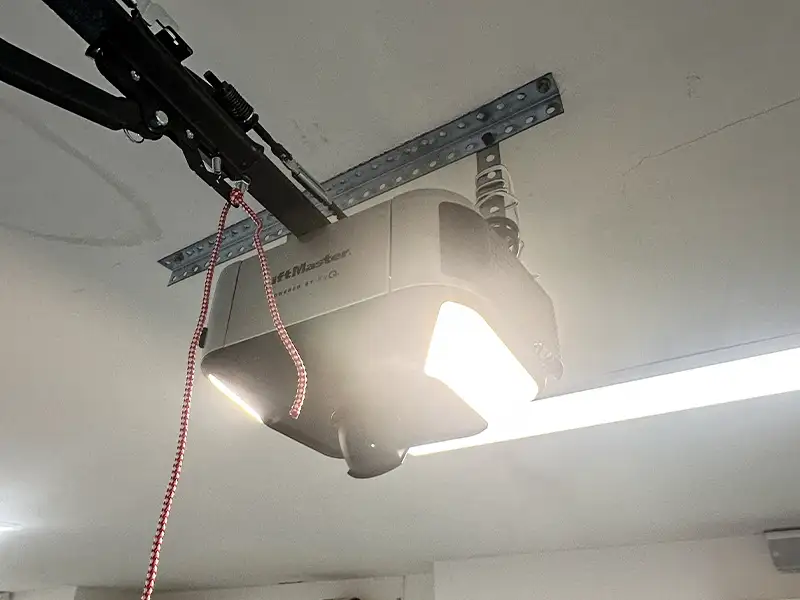
Genie states that its current model 7155 battery backup provides up to 50 cycles from the initial power failure. LiftMaster says the enclosed battery in its backup openers usually lasts one to two years depending on use and proper care, and that the opener provides a battery-status alert when replacement is needed.

Those are manufacturer statements for specific products and systems, not a promise that every battery or opener will perform the same way. Door weight, balance, temperature, battery age, installation, and the exact model all matter.

Strong Fit: Manual Operation Is Not Realistic for Everyone

An electric opener can stop when household power stops. A properly balanced garage door may still be opened manually after using the emergency release, but that is not a safe or practical plan for every person.

A tall or heavy door can be difficult to control. A door with a broken spring, damaged cable, binding track, or severe imbalance can fall or move unpredictably.

No. Stop using the door. This applies if it is crooked, unusually heavy, will not stay in position, has a broken spring, or has a loose cable. Do not pull the release and try to muscle it open; arrange garage door repair instead.

The U.S. Consumer Product Safety Commission says a severely unbalanced door can unexpectedly crash to the floor and that a door that binds, sticks, or is not balanced should be serviced by a professional. Battery backup is helpful, but it cannot correct a mechanical defect.

Strong Fit: You Want a Simpler Storm Plan

Northeast Florida residents do not need a sales pitch about storms. Jacksonville and the surrounding counties can see utility interruptions from wind, falling limbs, lightning, equipment failures, and other events.

Ready.gov advises households to identify what depends on electricity and plan for batteries or other alternate power sources. A charged opener battery can be one part of that plan, along with knowing the manual release procedure, keeping the door maintained, and leaving early when authorities issue evacuation instructions.

Battery backup does not make a garage door wind-rated, strengthen panels, or protect the opening from storm pressure. If wind performance is the concern, start with the door itself and review hurricane-compliant garage doors rather than expecting an opener battery to solve a structural issue.

When Is Battery Backup Not Worth the Added Cost?

Skip It When: Another Safe Exit Works

If the garage is detached, another exterior door gives dependable access, and no needed vehicle can be trapped, backup power may offer little practical benefit. A battery should solve a specific access problem, not become a box checked because a salesperson made it sound mandatory.

For a Jacksonville homeowner, the practical decision should come back to the house, the people using it, and the consequences of losing garage access. Buy the feature because it solves that problem, not because it appears on a product comparison sheet.

Repair First When: The Door Is Hard To Lift

Do not use battery power to cover up a door problem. The opener is designed to move a door whose springs and hardware carry and guide the load correctly.

If the door is heavy by hand, jerks, rubs, reverses without an obstruction, or makes new grinding noises, have the door inspected before choosing an opener. Repeatedly asking a motor and backup battery to move a binding or unbalanced door can reduce reliable performance and leave the underlying hazard in place.

A1A can evaluate the complete system through its garage door opener service. The right answer may be an opener with backup, a repair to the door, replacement of an aging opener, or no battery upgrade at all.

Skip a Retrofit When: Compatibility Is Unclear

Not every existing opener accepts an add-on battery. Some units have an integrated battery compartment, some use a model-specific accessory, and others were not designed for backup operation.

Do not buy a battery by voltage or appearance alone. The opener’s model number, manufacturer documentation, wiring design, available space, and control-board requirements have to match.

Electrical testing, internal wiring, and logic-board work are not DIY jobs. A wrong connection can damage the board, defeat safety functions, create shock or fire risk, or leave the door operating unpredictably.

Should You Replace the Opener or Add a Battery?

Choose an Integrated System When: The Opener Is Already Aging

A battery is only one part of an opener decision. If the existing unit is noisy, unreliable, incompatible with current safety accessories, or nearing replacement for other reasons, a new integrated backup model may make more sense than trying to adapt old equipment.

Current LiftMaster battery-backup options include belt-drive, chain-drive, and wall-mount configurations. Genie’s current battery-backup lineup also includes multiple models, including belt-drive units such as the 7155.

The drive style, door size, headroom, lighting, controls, smart connectivity, noise level, and serviceability deserve equal attention. A quiet belt-drive model may suit a garage below a bedroom, while another home may call for a different configuration.

Consider a Compatible Battery When: The Opener Supports It

If the opener runs well and the manufacturer specifically supports a replacement or accessory battery for that model, replacing a depleted battery can be sensible. Model verification comes first because similar-looking housings can use different parts.

Pay attention to the opener’s status light, beeps, or app notification as described in its manual. A battery that is installed but ignored can create false confidence until the next outage proves it no longer holds useful charge.

Replace the Door Problem First When: The Opener Is Straining

A fresh opener should not be treated as a stronger substitute for correct spring balance. The CPSC advises checking a door manually with the door closed before releasing it, and it warns that unbalanced or binding doors need professional service.

If the existing opener struggles, the first question is why. A trained inspection can separate a failing motor or control from worn rollers, damaged tracks, incorrect spring balance, or another door condition.

How much the Cost of Garage Door Opener Battery Backup in Jacksonville?

Cost Answer: The Setup Determines the Quote

There is no responsible single installed price that covers every Jacksonville home. A replacement battery for a compatible opener is a different job from installing a new battery-backup opener, and neither price says anything useful until the technician knows the model and door condition.

The total can change with the opener model, drive type, battery configuration, rail length, door height and weight, ceiling or wall-mount layout, electrical receptacle location, controls, accessories, removal of old equipment, and repairs needed to make the door operate safely. Product availability and manufacturer pricing also change.

Published national estimates are not a dependable substitute for seeing the actual door and selected equipment. A1A recommends a written quote tied to the model, installation conditions, and any door repairs that are genuinely needed.

That is the upfront answer. Ask what model is being proposed, whether the battery is included, what labor is included, what existing controls will work, and what future battery replacement involves.

How Should You Prepare and Maintain the Backup?

Before an Outage: Test the Whole System

Do not wait for storm warnings to learn how the opener behaves without utility power. Follow the manufacturer’s instructions for the exact model, confirm that the battery-status indication is normal, and make sure every regular user knows which entrance will work.

The door should also reverse correctly and the photoelectric sensors should be aligned and unobstructed. Battery operation does not bypass normal entrapment-protection requirements.

Have a professional address unexplained reversing, damaged wiring, burning odors, water intrusion, logic-board faults, or repeated battery errors. Do not remove covers and probe energized components.

During an Outage: Conserve Battery Cycles

Use the garage door only when needed. Repeated test cycles consume the same stored energy you may need later, and a long outage can outlast any opener battery.

If you must use the manual release, follow the owner’s manual and begin only with the door fully closed. Keep people clear, maintain control of the door, and stop if it feels unusually heavy, binds, hangs crooked, or will not stay in place.

Ready.gov also advises disconnecting appliances and electronics to reduce the chance of damage from surges when power returns. Follow the opener manufacturer’s instructions about reconnection and battery status after utility power is restored.

After an Outage: Check the Alerts

Restore normal operation according to the manual and verify that the door travels, stops, and reverses correctly. Listen for a battery warning and give the system time to recharge as the manufacturer directs.

If the backup did not operate, do not assume the battery alone is at fault. Charging circuitry, connections, battery age, opener settings, or a mechanical door problem may be involved, and internal electrical diagnosis belongs with a qualified service professional.

Frequently Asked Questions

Will a Garage Door Opener Work When the Power Is Out?

A standard electric opener will not run from household power during an outage. A compatible opener with a charged backup battery can operate for a limited number of cycles, while a properly balanced door may be operated manually by following its owner’s instructions.

Can I Add Battery Backup to My Existing Garage Door Opener?

Only if the manufacturer supports a battery or backup accessory for that exact model. Check the model label and documentation; do not improvise wiring or connect a generic battery to the logic board.

How Long Does a Garage Door Opener Battery Backup in Jacksonville Last?

There are two different questions: battery service life and outage capacity. LiftMaster says its enclosed battery usually lasts one to two years depending on use and care, while Genie says the model 7155 can provide up to 50 cycles from the initial power failure.

Does Battery Backup Make My Garage Door Hurricane-Rated?

No. Battery backup powers opener operation for a limited period; it does not change the door’s wind design, reinforcement, track, anchors, or approval status.

Can I Pull the Emergency Release During an Outage?

Follow the owner’s manual and start only with the door fully closed. Stop if the door is heavy, crooked, binding, has a broken spring, or has a loose cable, because the door can fall or move without control.

Do I Need Battery Backup if My Garage Has a Side Door?

Possibly not. If the side door provides dependable access and no essential vehicle or equipment would be trapped, battery backup may be a convenience rather than a need.

How Often Should the Backup System Be Checked?

Watch the opener’s battery-status alerts and use the test procedure and schedule in the exact model’s manual. Include the door’s balance, safety reversal, sensors, and hardware in routine professional service because backup power cannot overcome a mechanical defect.

What Is the Bottom-Line Decision?

Battery backup is worth considering when a power outage could trap a necessary vehicle, block the household’s practical exit, or force someone to handle a door they cannot safely control. It is less important when another safe entrance and transportation plan already solve the problem.

Start with the door’s condition, then choose the opener. A balanced, properly moving door with a compatible Genie or LiftMaster backup system is a sound plan; a struggling door with a battery attached is not.

A1A Overhead Door Company is a family-owned, non-franchised company founded in 2000 at 1520 Emma Ln, Neptune Beach, FL 32266. We serve Jacksonville and nearby communities across Duval, Nassau, Clay, and St. Johns counties in Florida, plus Camden County, Georgia.

Call 904-821-8463 or contact A1A Overhead Door Company to discuss the door, opener model, and access needs. We schedule service Monday through Saturday from 7 AM to 8 PM based on availability, and we are closed Sunday.

“When honesty, integrity, and the customer still count.”

Categories
Garage Door Installation & Replacement

Garage Door Panel Damage: Repair One Section or Replace the Whole Door?

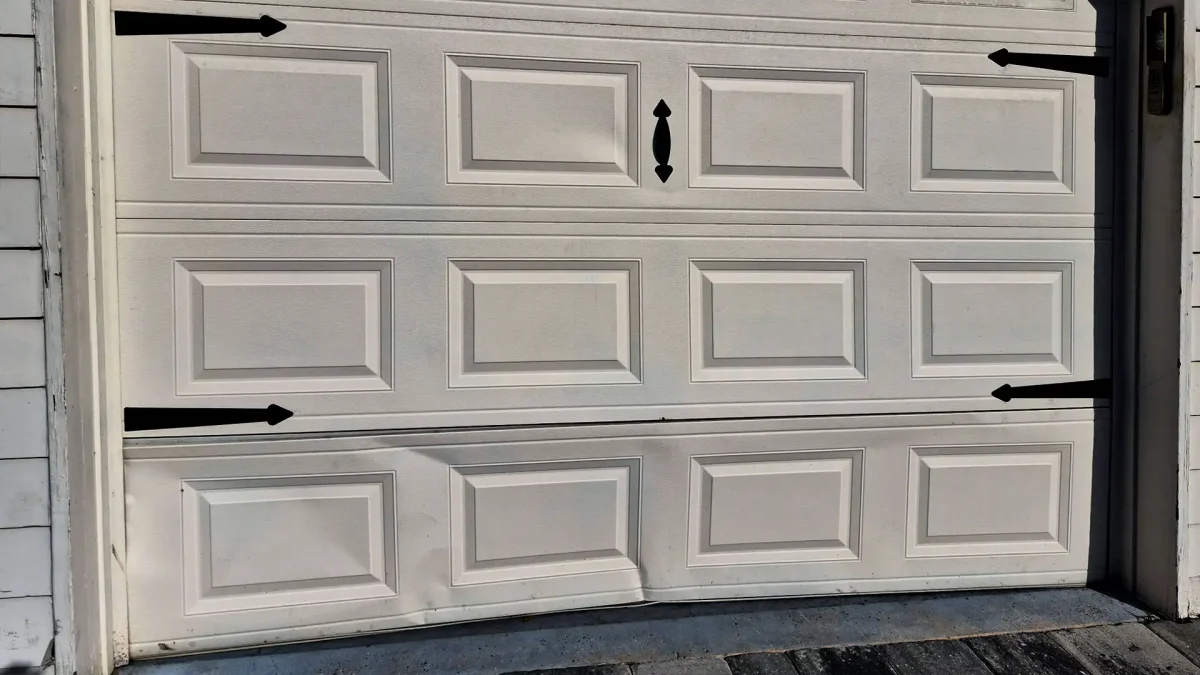
You back out before sunrise, hear metal scrape, and see the bottom section of your garage door folded inward. The opener strains, the door rises six inches, and one side hangs lower than the other.

A1A Overhead Door Company helps Jacksonville-area homeowners decide whether that damage calls for one section or an entire new door. We are a family-owned, non-franchised company based at 1520 Emma Ln in Neptune Beach, incorporated in 2000, and we give direct answers without dressing up a bigger sale as the only option.

The honest answer is that a damaged panel can sometimes be replaced by itself. It can also be the visible part of a larger structural problem, especially when the impact has affected hinges, tracks, rollers, cables, or the door’s wind-rated assembly.

This guide explains what separates a sensible panel replacement from money spent postponing the inevitable.

Can One Garage Door Panel Damaged Section Be Repaired?

Yes, if the damage is limited and the correct replacement section is available. Amarr explains that some doors can be repaired with a section replacement, while older doors may require complete replacement because door dimensions and technology have changed.

A garage door is not one sheet of metal. Most residential doors are made from horizontal sections joined by hinges, so a technician may be able to remove one damaged section and install a matching one without discarding the rest of a sound system.

Damage Limited to One Section

A single-section replacement is most promising when one panel has a shallow-to-moderate dent, split skin, localized corrosion, or impact damage that has not distorted adjacent sections. The door should still sit square in the opening, and the tracks, hinges, rollers, end stiles, cables, and spring system must remain serviceable.

Cosmetic damage and structural damage are not the same. Scratched paint may need surface work, while a crease across a section can weaken it even if the opener still moves the door.

A Replacement Section That Actually Matches

The manufacturer, model, section height, panel profile, insulation construction, color, and reinforcement all matter. A section that looks close from the driveway may have the wrong weight, thickness, hinge spacing, or internal construction.

That is why we identify the door before quoting a section. A1A works with C.H.I. and Amarr doors, and we assess whether a correct section is available rather than promising a match before seeing the system.

The Rest of the Door Is Worth Keeping

Panel replacement makes sense when the remaining sections are solid, the hardware is in reasonable condition, and the door has useful service life left. It is harder to justify when the other sections are rusting, delaminating, sagging, or repeatedly needing repairs.

The question is not simply, “Can this section be changed?” The better question is, “Will the complete door be safe, compatible, and worth owning after it is changed?”

When Should You Replace the Whole Garage Door?

Replace the whole door when a new section would leave you with an unreliable, mismatched, or questionable system. Spending less today is not a bargain if another major repair is already visible.

Multiple Sections Are Bent or Separated

An impact can travel beyond the obvious dent. If two or more sections are bowed, hinge mounting points are torn, or the tongue-and-groove joints no longer meet correctly, isolated panel work may not restore proper travel or sealing.

Look at the door from inside with it fully closed, but do not touch spring or cable hardware. Daylight between sections, uneven gaps, and sections that no longer stack evenly deserve a professional inspection.

The Door Is Older and Parts Are Scarce

A discontinued model can turn a simple idea into an expensive hunt. Amarr notes that limited parts availability can make repairs to older doors costlier, and it identifies age and poor operation as reasons to consider replacement.

Even when a used or “close enough” panel can be found, it may not belong in that door system. We would rather tell you a match is not responsible than force incompatible parts together.

Structural Damage Reaches the Hardware

A bent section can pull hinges out of line, push rollers against the track, or change how load moves through the door. An opener may keep dragging the door for a while, but that does not prove the door is balanced or safe.

If the door is crooked, unusually heavy, supported by one side, or shows spring or cable damage, the answer to “Can I keep using it?” is simple: No. Stop using the door. Do not pull the emergency release, loosen brackets, or try to straighten the section.

DASMA warns that spring-system cables and bottom brackets are associated with high tension and should be handled by trained technicians. It also says awkward manual operation can indicate an out-of-balance spring system.

Appearance and Performance No Longer Line Up

A replacement panel can be mechanically correct and still look different. Years of sun, salt air, paint fade, and surface wear can make a new factory-finished section stand out against the old ones.

Some owners accept that difference to preserve a good door. Others decide that a complete garage door installation is the better use of the budget because it addresses appearance, insulation, hardware compatibility, and remaining service life at once.

Does Jacksonville Weather Change the Decision?

It should. Jacksonville, the Beaches, Nassau County, Clay County, St. Johns County, and Camden County face wind, wind-driven debris, heavy rain, humidity, and coastal exposure that can turn “just a dent” into a performance question.

Wind Rating Is a System Question

Wind-rated doors are selected for a location and opening, not by picking a strong-looking panel. Amarr’s residential wind-load tool uses factors including basic wind speed, exposure category, impact-resistance needs, building dimensions, enclosure classification, and door-opening size.

That matters after panel damage because the complete assembly includes sections, reinforcement, track, brackets, fasteners, and installation details. A substitute section should not be assumed to preserve the door’s documented configuration.

If a damaged section belongs to a storm-rated door, identify the door and verify the replacement path before work begins. A1A can also explain when moving to a hurricane-compliant garage door is the sounder option for the opening.

Corrosion Can Be More Than Surface Deep

Salt exposure and humidity can work into chipped finishes, section edges, hardware attachment points, and bottom areas that stay damp. Rust staining alone does not decide the job, but corrosion around fasteners or reinforcement deserves closer attention.

A new bottom section on top of three deteriorating sections is rarely a strong long-term plan. The condition of the full door has to drive the recommendation.

Water and Wind Sealing Matter

A creased section may no longer meet the adjacent section evenly or press against perimeter seals as intended. That can admit wind-driven rain and place uneven stress on hinges and rollers during operation.

Panel damage near the bottom seal can also prevent the door from closing evenly. If the door does not reach the floor squarely, stop treating the issue as cosmetic.

What Does Garage Door Panel Replacement Cost in Jacksonville?

There is no responsible flat range that covers every Jacksonville panel job. A basic section on a common door and a reinforced section on a storm-rated assembly are different jobs, so the useful number is a written quote for the exact door and damage.

The Door Identification Changes the Price

A basic non-insulated section and an insulated, reinforced, windowed, or specialty-finish section are different parts. Width, section height, steel gauge, backing material, glass, design, and manufacturer all affect availability and cost.

Shipping can matter because a garage door section is large and easily damaged in transit. A discontinued section may be unavailable at any reasonable price even when the labor itself would be straightforward.

The Damage Beyond the Panel Changes the Scope

The quote may include hinges, rollers, struts, brackets, track correction, weather seal, or other components damaged in the same event. Spring work is a separate safety-sensitive scope and should never be treated as a casual add-on.

A1A starts with the full door, not just the dent. Our garage door panel replacement service explains how we inspect the frame, hardware, and all sections before recommending work.

Compare the Complete Numbers

Ask for the installed panel-replacement price and the installed whole-door price based on the same opening. Then compare what remains old, what becomes new, whether the appearance will match, and whether the repaired assembly is appropriate for the location.

A low panel quote is not automatically the smart choice. A full replacement is not automatically necessary either.

What Will a Technician Check Before Recommending Repair or Replacement?

A good decision comes from inspection, identification, and comparison. It does not come from one photo of the dent.

Door and Section Identification

The technician should look for labels, model information, section dimensions, panel pattern, construction, reinforcement, and color. This determines whether a suitable section exists and what manufacturer guidance applies.

Photos are useful for starting the conversation, but measurements and on-site condition settle it. Do not order a panel from appearance alone.

Alignment and Operating Condition

The inspection should cover how the door sits in the opening, how sections meet, and whether tracks, rollers, hinges, and attachment points were shifted. The technician should also evaluate door balance and the spring-and-cable system without asking the homeowner to operate a dangerous door.

DASMA says the track and sections work together as a system and recommends using track designed for the specific replacement door. That is particularly important when the conversation changes from one section to a whole new door.

Wind-Load and Opening Requirements

For a storm-rated assembly, the technician needs to account for the installed door configuration and the requirements applicable to the opening. Product selection should be based on documented requirements, not a vague “hurricane door” label.

If complete replacement is recommended, ask what door, track, reinforcement, and hardware are included. Our job is to explain what you are buying and why.

How Do You Make the Final Repair-or-Replace Decision?

Choose panel replacement when damage is truly isolated, a compatible section is available, the remaining door is sound, and the installed cost makes sense. Choose complete replacement when damage is widespread, compatibility is uncertain, the door is deteriorated, or the repair leaves too much old risk behind.

The Upfront A1A Test

We weigh safety first, compatibility second, and value third. Appearance matters, but it does not override a crooked door, compromised attachment points, or the wrong section for a rated assembly.

That is the plain answer Jimmy Fuqua expects the company to give. “When honesty, integrity, and the customer still count” means telling you when one section is enough and when it is not.

Schedule an Assessment

Call 904-821-8463 during our business hours, Monday through Saturday from 7 AM to 8 PM. We are closed Sunday, and appointment timing depends on the schedule when you call.

A1A serves Jacksonville and nearby communities across Duval, Nassau, Clay, and St. Johns counties in Florida, plus Camden County, Georgia. If the issue extends beyond the panel, our garage door repair team can evaluate the complete system.

Categories
Garage Door Repair & Troubleshooting

Garage Door Won’t Open but the Motor Runs? 7 Checks Before You Call

You press the wall button on a hot Jacksonville morning. The opener whirs above you, but the door stays planted on the floor and your car is trapped inside.

A1A Overhead Door Company handles this exact problem across Jacksonville and the surrounding counties. We are a family-owned, non-franchised company based at 1520 Emma Ln in Neptune Beach, Florida, and we have been incorporated since 2000.

Here is the upfront answer: a running motor does not prove the opener is doing its job. The sound tells you electricity reached at least part of the unit, but the failure may be in the connection to the door, the drive system, the door itself, or the opener controls.

The search phrase “garage door won’t open but the motor runs” describes a symptom, not a diagnosis. These seven inspection checks can narrow it down, but they are not permission to take apart a spring system, opener motor, or logic board.

Know When Not to Troubleshoot

Look at the closed door from inside the garage before touching anything. If the door is crooked, a cable is loose or off a drum, a spring has a visible gap, a roller has left the track, or a section is folding, do not press the button again.

No. Stop using the door.

Do not pull the emergency release when a door is raised, crooked, or unsupported. A disconnected door can fall if a spring or cable is no longer carrying its share of the load.

Genie warns against operating a jammed door or one with a broken spring. DASMA also says high-tension spring systems and worn cables should be handled by trained technicians.If you see damage, skip the checks and arrange garage door repair in Jacksonville.

1. Check Whether the Trolley or Carriage Is Disconnected

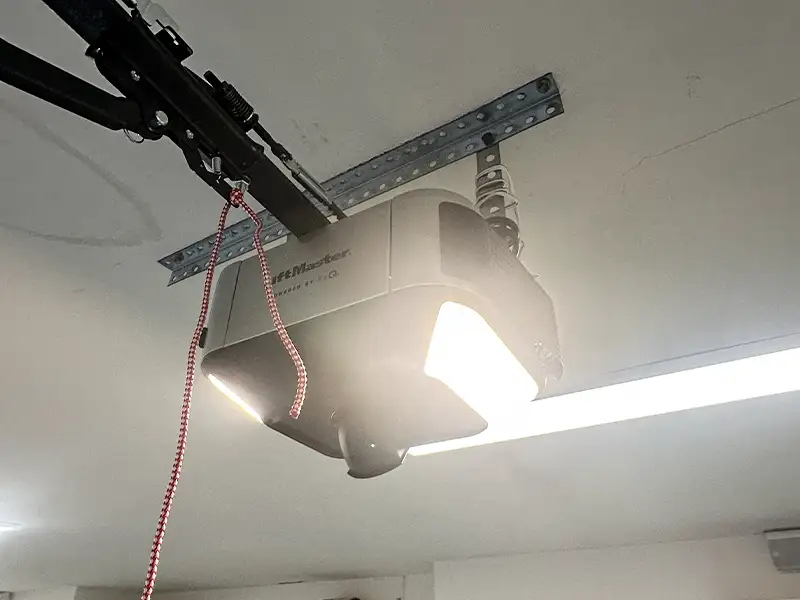
The opener motor moves a trolley or carriage along the rail. That moving piece connects to the door through a metal arm. Pulling the red emergency-release cord separates the door from the opener so the door can be operated manually during a power outage or service situation.

If someone pulled the cord recently, the motor may run and the trolley may travel without moving the door. From the floor, with the door fully closed, look up at the rail and watch whether the moving trolley is actually connected to the door arm.

Stay on the floor, keep fingers away, and do not repeatedly cycle the opener.

Reconnection steps differ by design. Check the owner’s manual for the exact Genie or LiftMaster model rather than forcing two parts together.

If the door reconnects but releases again, stop. A worn trolley, damaged release mechanism, or door resistance needs more than a reset.

2. Make Sure the Manual Lock Is Not Engaged

Some garage doors have a center slide lock, side lock bar, or exterior keyed lock. If that lock is engaged while an automatic opener tries to lift the door, the motor may run, hum, or strain against a door that cannot move.

With the door fully closed and the opener idle, inspect the inside face of the door. Confirm that no lock bar extends into either vertical track and that no padlock or security device is holding the door down.

Do not keep pressing the opener to “power through” a lock. That can damage the top section, opener arm, trolley, rail, or internal drive parts.

If a lock was the cause, disable it according to the door and opener instructions so it cannot be engaged accidentally. Genie calls for garage-door locks to be removed or disabled in the open position when an opener is installed.[3]

3. Look for a Broken Spring or Cable Problem

The opener is not supposed to deadlift the full weight of the door. The spring system counterbalances that weight so a correctly matched opener can guide the door through its travel.

A torsion spring above the door may show a clear gap in the coil when it breaks. An extension spring along a horizontal track may be stretched, separated, or hanging abnormally. A lift cable may be slack, frayed, tangled near a drum, or missing tension on one side.

If you see any of those conditions, the answer is not a stronger opener. DASMA states that a door requiring two hands to lift is probably out of balance and that openers are designed for properly balanced doors.[2]

No. Stop using the door.

Do not loosen a set screw, touch a cable drum, adjust a bottom bracket, wind a spring, or cut a cable. Spring-loaded components can move with severe force, and DASMA specifically identifies bottom brackets and spring-connected cables as high-tension parts for trained technicians.[1]

Our garage door spring repair service covers torsion and extension spring problems. A technician should identify the spring setup, cable condition, and related damage.

4. Test the Door’s Movement Only If It Looks Safe

This check is only for a fully closed door that is straight, supported, and visibly intact. If you saw a spring gap, loose cable, crooked section, damaged track, or heavy-door warning sign, do not disconnect it.

Switch off or unplug the opener only if the plug is safely reachable without climbing over the door or working near exposed wiring. With the door fully closed, use the emergency release as described in the owner’s manual, then lift using the proper handle.

A healthy, balanced door should move smoothly without binding. It should not shoot upward, slam down, become extremely heavy, or jam at one point. DASMA says awkward manual operation can indicate an out-of-balance spring system and should be repaired by a trained professional.[1]

If the door is crooked or heavy, no. Stop using the door. Keep everyone clear and call for service..

If the door moves smoothly by hand, the problem is more likely in the opener connection, travel system, or internal drive. Reconnect only according to the opener manual and do not operate the unit if the rail, arm, or trolley looks damaged.

5. Watch What Moves Along the Opener Rail

From the floor and at a safe distance, make one brief observation while another adult presses the wall control. The motor sound alone is vague; what moves, and what does not, narrows the diagnosis.

If the trolley travels but the door does not, suspect a disconnected or damaged trolley connection. If the chain or belt moves but the trolley does not, the carriage may be stripped or broken. If the motor runs while neither the chain, belt, screw, nor trolley moves, an internal gear, sprocket, coupler, or drive component may have failed.

Stop after one short test. Repeated operation can cause more damage or overheat a struggling opener.

Do not remove the opener cover. Internal components can include stored electrical energy, sharp moving parts, and wiring that should not be treated as a homeowner repair. Logic-board diagnosis and electrical work are not DIY work.

A1A services Genie and LiftMaster opener systems. Our garage door opener repair and installation page explains the opener types we handle throughout the Jacksonville area.

6. Listen for a Hum, Grind, Click, or Normal Travel Sound

The exact sound matters. A normal-length motor run with no door movement often points toward a lost mechanical connection. A short hum followed by a stop can indicate binding, a stalled motor, or a door the opener cannot lift.

Grinding or rattling suggests that continuing to run the unit may cause more damage. A click with little or no motor sound may involve a control, relay, capacitor, or power issue, but sound alone is not a reliable parts diagnosis.

Note how long the sound lasts, whether the light flashes, and the brand and model number if readable from the floor.

Do not probe terminals, bypass safety devices, replace capacitors, splice wires, or open the logic-board compartment. Electrical and logic-board work should be diagnosed by a technician using the correct documentation for that model.

Stop if you smell burned plastic or see smoke, arcing, melted insulation, or heat discoloration. Disconnect power only if safely reachable, keep the opener off, and have it inspected.

7. Check the Travel Path and Door Sections for Binding

A motor may run while the door stays down because the door or hardware is physically bound. Look from the floor for an object in the track, a bent track, a shifted roller, a damaged hinge, or a top section pulled inward around the opener bracket.

Do not hammer the track, force a roller back in, or loosen track brackets while the door is under load. Do not put hands between sections. DASMA advises using proper handles or gripping points and keeping fingers out of section joints during manual operation.[1]

A dented panel is not always cosmetic. A bowed section or torn opener bracket can bind the door.

A technician can determine whether hardware adjustment, reinforcement, garage door panel replacement, or a larger repair is the honest answer. We work with doors from C.H.I. and Amarr, but panel availability, design, age, color, and damage location all affect whether replacement is practical.

What This Repair May Cost

There is no responsible one-price range for “the motor runs but the door won’t open.” The same symptom can be a disconnected carriage, a broken trolley, an internal opener failure, a damaged top section, a broken spring, or a cable problem.

The quote depends on the failed component, opener model, door weight, spring configuration, parts availability, panel match, diagnosis, and related damage.

We are not going to publish a broad national number and pretend it predicts your repair. The useful comparison is the written scope: what failed, what caused it, which parts are being replaced, and whether the door is safe and balanced after the work.

Sometimes repair makes sense. An older opener with several worn components may not be worth chasing, and we will say so.

FAQ: Garage Door Motor Runs But Door Won’t Open

Why does my garage door won’t open but the motor runs ?

The sound of the motor confirms the unit is receiving power, but a mechanical connection has failed. The most common causes include:

  • The emergency release cord was pulled, disconnecting the trolley from the door arm.
  • A manual slide lock or side lock bar is actively engaged.
  • A torsion or extension spring has broken, leaving the door too heavy to lift.
  • Internal drive gears, sprockets, or couplers inside the opener are stripped.

What should I do if my garage door opener is humming or grinding?

A short hum followed by a stop usually indicates the door is physically bound or too heavy for the opener to lift. A grinding or rattling sound suggests stripped internal gears or a broken carriage. Stop pressing the wall control immediately, as repeated operation can overheat the motor or cause further damage to the drive system.

Can I manually open my garage door if the spring is broken?

No. Stop using the door and keep everyone away from the opening. Springs counterbalance the full weight of the garage door. If a spring is broken, pulling the emergency release removes the opener’s support, which can cause the door to fall heavily. High-tension spring systems must be replaced by trained technicians.

How do I check if my garage door is locked?

With the door fully closed and the opener turned off, inspect the inside face of the door panels. Look for a center slide lock, a side lock bar extending into the vertical tracks, or an exterior keyed padlock. If a lock is engaged, disable it completely before attempting to run the automatic opener again to avoid damaging the top door section or the opener arm.

Why is the opener trolley moving on the rail, but the door stays on the floor?

If the trolley travels back and forth along the rail but the door does not move, the door has been disconnected from the automatic opener. This usually happens when the red emergency-release cord is pulled. Check your specific Genie or LiftMaster owner’s manual for instructions on how to properly reconnect the trolley to the door arm.

How much does it cost to fix a garage door that won’t open?

There is no single flat rate because the same symptom can stem from entirely different mechanical failures. Repairing a disconnected carriage is a minor fix, while replacing stripped internal gears, broken high-tension springs, or damaged C.H.I. or Amarr panels requires specific parts and labor. A precise quote depends on the failed component, door weight, and necessary replacement parts.

When to Call A1A Overhead Door Company

Call when the trolley will not reconnect, the opener grinds or hums without moving the drive, the door binds, or the cause remains unclear after the safe visual checks. Call immediately if you see a broken spring, loose cable, crooked door, damaged top section, or a door that feels heavy.

A1A Overhead Door Company serves Jacksonville and nearby communities across Duval, Nassau, Clay, and St. Johns counties in Florida, plus Camden County, Georgia. For local service details, visit our Jacksonville garage door service page.

Our regular hours are Monday through Saturday, 7 AM to 8 PM. We are closed Sunday.

Call 904-821-8463 or contact A1A Overhead Door Company to schedule an inspection. “When honesty, integrity, and the customer still count.”
Categories
Blog Garage Door Installation & Replacement

Which Garage Door Opener Fits Your Jacksonville Home?

garage-door-openers-section

Choosing the right garage door opener isn’t always straightforward, especially with multiple drive types and features to consider. The right choice depends on your door’s weight, your garage’s layout, how often you use the door, and even how much noise you’re willing to live with. Getting it right the first time also means fewer garage door repair calls down the road, since the wrong opener for your setup tends to wear out faster and strain other parts of the system.

Here’s a practical breakdown of the opener types available for Jacksonville homes and how to figure out which one actually fits yours.

Why the Right Opener Choice Matters

A garage door opener does more than just lift and lower the door. It works alongside the springs, tracks, and cables as one connected system. An opener that’s mismatched to your door’s weight or usage pattern puts extra strain on everything else, which often shows up later as a spring failure, track misalignment, or a motor that burns out well before it should.

Picking the right opener from the start, or replacing an aging one before it fails completely, is one of the simpler ways to avoid an unplanned garage door repair down the line.

Belt Drive Openers

Belt drive openers use a rubber belt reinforced with steel to move the door along the track. They’re one of the quieter options available, which makes them a strong fit for garages that sit right below a bedroom or living space.

Best For

  • Homes with a garage under or beside frequently used rooms
  • Anyone who wants a quieter opener without giving up reliability
  • Daily use where consistent, smooth operation matters

Belt drive systems tend to run smoothly over time with less noticeable wear noise, though like any opener, they still need occasional inspection to keep the belt tension correct and the track clear.

Chain Drive Openers

Chain drive openers use a metal chain to pull the door along the track, similar to a bicycle chain. They’re a proven, durable option and tend to be more budget-friendly than belt drive systems.

Best For

  • Detached garages or garages farther from living spaces where noise is less of a concern
  • Heavier doors that need a strong, dependable lifting mechanism
  • Homeowners looking for a reliable option without a premium price tag

Chain drive openers are workhorses, but they do run louder than belt drive systems, and the chain itself needs periodic lubrication to keep operating smoothly.

Wall-mount Openers

Wall-mount openers sit on the wall beside the door rather than running along the ceiling track. This frees up ceiling space, which is useful for garages with limited overhead clearance or homeowners who want to use that space for storage.

Best For

  • Garages with high ceilings used for storage racks or lifts
  • Homes where ceiling space is at a premium
  • Anyone wanting a cleaner, less cluttered garage ceiling

Because the mechanism is positioned differently than a traditional track-mounted opener, wall-mount systems are often a good match for garages that don’t fit the standard layout.

Matching the Opener to Your Door

Beyond drive type, the opener itself needs to be sized correctly for your door’s weight and daily use.

Door Weight and Size

A heavier door, such as a solid wood or insulated steel door, needs an opener with enough horsepower to lift it consistently without straining the motor. An opener that’s underpowered for the door will wear out faster and put uneven stress on the springs and tracks.

Frequency of Use

A door that opens and closes multiple times a day, especially for a primary vehicle entrance, benefits from a heavier-duty opener built for frequent cycling. A secondary or rarely used door has more flexibility in opener choice.

Existing Hardware Condition

If your current springs, tracks, or cables are already worn, installing a new opener without addressing that wear just shifts the strain onto a new motor. A full inspection before installing a new opener helps confirm the rest of the system is ready to support it.

Signs Your Current Opener Needs Attention

Sometimes the decision isn’t about upgrading proactively but responding to a system that’s already struggling.

Warning Signs to Watch For

  • The opener strains, stalls, or reverses unexpectedly during operation
  • Grinding, screeching, or unusual noises coming from the motor unit
  • The door opens or closes unevenly, or hesitates partway through the cycle
  • The remote or wall switch works inconsistently
  • The opener runs but the door doesn’t move, which often points to a belt, chain, or gear issue rather than the opener itself

Catching these signs early usually means a simpler garage door repair rather than a full opener replacement.

LiftMaster and Genie Openers for Jacksonville Homes

A1A Overhead Door repairs and installs LiftMaster and Genie openers across belt, chain, and wall-mount systems for residential properties throughout Jacksonville and the surrounding area. Both brands offer reliable options across different drive types, and the right fit comes down to your specific door, garage layout, and how you use it day to day.

Why Brand and Installation Quality Both Matter

An opener is only as good as its installation. Even a well-built LiftMaster or Genie unit will underperform if it’s not properly aligned with the door’s travel, safety sensors, and existing hardware. That’s why opener installation and garage door repair should be handled by someone familiar with the full system, not just the motor unit itself.

Getting Opener Installation and Repair Done Right in Jacksonville

A1A Overhead Door has been serving Jacksonville and the surrounding communities for nearly 30 years as a family-owned, non-franchised business. Whether you’re installing a new opener, replacing an aging one, or dealing with a garage door repair that’s turned out to involve the opener itself, our team assesses the full system rather than just swapping parts.

Licensed and Locally Accountable

Every installation and repair is performed under our own county specialty contractor licenses, GD17 in Duval County and BL5747 in St. Johns County, never subcontracted out to a crew you haven’t met.

Backed by a Real Warranty

Opener installations and repairs are backed by a one year warranty on parts within the scope of the work performed. If something needs attention afterward, we come back out.

Frequently Asked Questions

What’s the difference between a belt drive and chain drive opener? Belt drive openers use a reinforced rubber belt and run quieter, making them a good fit for garages near living spaces. Chain drive openers use a metal chain, run louder, and tend to be more budget-friendly while still offering strong, dependable lifting power.

Is a Wall-mount opener a good option for every garage? Wall-mount openers work well for garages with limited ceiling clearance or homeowners who want the ceiling space free for storage. They’re less about being universally better and more about fitting a specific garage layout.

Can I install a new opener without checking the rest of my garage door system? It’s not recommended. An opener works alongside the springs, tracks, and cables, so worn hardware can strain a new opener and shorten its lifespan. A full inspection before installation helps the new opener perform the way it should.

Do LiftMaster and Genie openers require different maintenance? Both brands are reliable when properly installed and maintained, and general upkeep like checking the drive mechanism and keeping tracks clear applies across both. Specific maintenance needs can vary by model, so it’s worth asking your technician what your particular unit needs.

What areas does A1A Overhead Door serve for opener installation and garage door repair? A1A Overhead Door serves Jacksonville, Neptune Beach, Atlantic Beach, Jacksonville Beach, Ponte Vedra, Ponte Vedra Beach, Nocatee, Fernandina Beach, Amelia Island, Yulee, Callahan, Hilliard, Orange Park, Middleburg, Green Cove Springs, St. Augustine, St. Augustine Beach, Kingsland, St. Marys, Woodbine, and nearby communities across Duval, Nassau, Clay, and St. Johns Counties in Florida and Camden County in Georgia.

Find the Right Opener for Your Home

Choosing between belt, chain, and wall-mount openers comes down to your garage’s layout, your door’s weight, and how you use it every day. A1A Overhead Door has been helping Jacksonville homeowners make that decision, and handling the garage door repair work that comes with it, for nearly 30 years. Call (904) 821-8463 today to talk through the best opener option for your home or to schedule a repair on your current system.

Categories
Blog Garage Door Repair & Troubleshooting

Is Your Garage Door Ready for Hurricane Season?

four-section sectional garage door

Hurricane season puts every part of a Florida home to the test, and the garage door is often the weakest point in that equation. A poorly maintained or outdated door can fail under wind pressure, letting storm forces into the garage and putting the rest of the house at risk. Before the next storm system rolls toward the coast, it’s worth taking a close look at whether your door and its components can actually hold up.

For homeowners across Jacksonville, Neptune Beach, Fernandina Beach, Ponte Vedra, and the surrounding communities, this isn’t a hypothetical concern. It’s a yearly reality that makes routine garage door service just as important as boarding windows or stocking supplies.

Why Garage Doors Matter So Much During a Hurricane

Most people think about roofs and windows when they prepare for a storm, but the garage door is one of the largest openings on any home. When it fails, wind can rush into the garage and push upward on the roof from the inside, which is a common cause of structural damage during hurricanes.

This is exactly why Florida’s building code has required wind load rated garage doors since 2002. That standard exists because engineers and building officials recognized how much damage an unsecured or under built garage door could cause once high winds got behind it.

What Happens When a Garage Door Fails in High Winds

A few different failure points tend to show up during storms:

  • Panels buckle or blow inward under sustained wind pressure
  • Tracks bend or pull away from the wall, letting the door detach
  • Weak or worn springs snap under the added strain of wind load
  • Older doors without wind-rated components simply were not built for the pressure.

Any one of these can turn a garage door into an open gap in your home’s defense during a storm.

Signs Your Garage Door Needs Attention Before Storm Season

You do not need to be a contractor to spot most warning signs. A little attention now can prevent a much bigger problem later.

Visual and Physical Warning Signs

  • Visible dents, cracks, or panel damage
  • Rust or corrosion on tracks, hinges, or hardware
  • A door that shudders, sticks, or moves unevenly when opening and closing
  • Gaps around the edges of the door where daylight is visible
  • An opener that struggles, reverses unexpectedly, or makes grinding noises

Age and Installation Red Flags

If your home was built or your garage door was installed before 2002, there’s a good chance it was never engineered to meet Florida’s wind load requirements at all. Even doors installed after that date can lose integrity over time as springs weaken, hardware corrodes in the coastal humidity, and tracks shift slightly out of alignment.

What a Pre-Hurricane Garage Door Service Should Cover

A proper inspection ahead of storm season goes beyond a quick glance. It should cover every part of the system that keeps the door secured and functioning.

Spring and Hardware Inspection

Torsion and extension springs carry the physical load of the door and are one of the first components to show wear. A qualified technician checks that springs are sized correctly for your specific door, not just replaced with a generic match. Worn springs under wind load are far more likely to snap at the worst possible moment.

Track and Panel Assessment

Tracks need to be straight, properly bolted, and free of rust or bends. Panels should be checked for hidden cracks or weak points, not just obvious damage. A door can look fine from the driveway and still have issues that only show up under pressure.

Opener and Safety Feature Check

Belt, chain, and wall mount openers all need to engage and disengage smoothly. A struggling opener puts more strain on the rest of the door system and can be an early indicator of a bigger mechanical issue.

Wind Load Compliance Review

For homes in Duval and St. Johns Counties, doors installed or replaced need to meet the wind load standards required by local building code. A technician licensed in these counties can confirm whether your current door meets that standard or whether an upgrade makes sense before storm season arrives.

Repair, Reinforce, or Replace: Making the Right Call

Not every door that shows wear needs to be replaced. The right decision depends on the door’s age, its current condition, and whether it was built to meet wind load standards in the first place.

When Repair Makes Sense

If the door itself is structurally sound and wind rated, but individual components like springs, rollers, or hardware are worn, targeted repairs usually solve the problem. Visible panel damage does not automatically mean the whole door needs replacing. An honest assessment of the full door should always come before deciding what work is actually needed.

When Replacement Is the Safer Investment

Homes with pre-2002 doors, or doors that were never rated for hurricane conditions, are better served by installing a new hurricane-compliant door. This is especially true for coastal properties in Atlantic Beach, Fernandina Beach, and Amelia Island, where wind exposure tends to be more direct.

Frequently Asked Questions

How often should I schedule garage door service before hurricane season? An annual inspection before the start of hurricane season is a reasonable baseline for most homes. Coastal properties dealing with more humidity and salt air may benefit from checking hardware condition more frequently, since corrosion tends to progress faster near the coast.

Does my current garage door meet Florida’s hurricane code? It depends on when the door was installed. Florida has required wind load rated garage doors since 2002, so any door installed before that likely does not meet current code. A licensed technician can inspect your specific door and confirm its rating.

Can a garage door opener affect how well the door holds up in a storm? Yes. A properly functioning opener keeps the door moving evenly and helps avoid added strain on tracks and panels. An opener that is already struggling can accelerate wear on other parts of the system, which becomes more noticeable under storm conditions.

Is panel damage on my garage door something to worry about before a storm? It depends on the extent and location of the damage. Some panel damage is cosmetic, while other damage can compromise the door’s structural integrity. A full assessment is the only reliable way to know which situation you’re dealing with.

What counties does A1A Overhead Door serve for garage door service? A1A Overhead Door serves Duval, Nassau, Clay, and St. Johns Counties in Florida, along with Camden County in Georgia. This includes Jacksonville, Neptune Beach, Atlantic Beach, Jacksonville Beach, Ponte Vedra, Ponte Vedra Beach, Nocatee, Fernandina Beach, Amelia Island, Yulee, Callahan, Hilliard, Orange Park, Middleburg, Green Cove Springs, St. Augustine, St. Augustine Beach, Kingsland, St. Marys, Woodbine, and nearby communities.

Get Your Garage Door Storm Ready Today

Hurricane season does not wait for anyone to be ready, which is why getting ahead of it matters. A1A Overhead Door has been providing garage door service to Jacksonville and the surrounding communities for nearly 30 years as a family-owned, non-franchised business. Every inspection, repair, and installation is performed under our own county specialty contractor licenses, GD17 and BL5747, and backed by a one-year parts warranty on the work we complete.

Whether your door needs a straightforward inspection, a spring repair, or a full upgrade to a hurricane-compliant model, our team will give you an honest assessment of what it actually needs before any work begins. Call A1A Overhead Door today at (904) 821-8463 to schedule your pre-storm garage door service and head into hurricane season with confidence.

Categories
Blog Garage Door Maintenance, Safety & Hurricane Protection

Need 24 Hour Garage Door Spring Repair in Jacksonville? Here’s What You Should Know First

Garage Door Panel Replacement

A broken garage door spring rarely picks a convenient time to fail. It’s usually late at night, early before work, or right in the middle of a weekend when you’re trying to leave for an appointment. If you’re searching for 24 hour garage door spring repair in Jacksonville, you’re probably staring at a door that won’t budge or one that slammed down faster than it should have, and you need real answers, not just a phone number.

Here’s what actually matters when a spring fails, what to expect from a repair, and how to find a company that will show up and do the job right.

Why Garage Door Springs Fail Without Warning

Garage door springs carry the full weight of the door every single time it opens or closes. Over thousands of cycles, that constant tension wears the metal down until it eventually gives out. Most homeowners never see it coming because the visible signs are easy to miss until the spring actually snaps.

Torsion Springs vs Extension Springs

Jacksonville homes typically have one of two spring types, and knowing which one you have matters for both safety and repair.

  • Torsion springs sit horizontally above the door and twist to create lifting tension. They tend to last longer but store more energy, which makes them more dangerous to handle without the right tools.
  • Extension springs run along the horizontal tracks on either side of the door and stretch to create tension. They’re common on older installations and wear differently than torsion springs.

Both types need to be sized correctly for the specific weight and dimensions of your door. A spring that’s close enough but not quite right will wear out faster and put more strain on the opener and tracks.

Common Warning Signs Before a Spring Breaks

A spring rarely fails with zero warning. Look for:

  • A loud bang from the garage, which is often the sound of the spring itself snapping
  • The door feeling unusually heavy when you try to lift it manually
  • Visible gaps or separation in the coil of the spring
  • The door closing too fast or dropping unevenly
  • Cables that look loose or frayed near the spring assembly

If you notice any of these, it’s worth getting the door looked at before it fails completely, ideally during regular business hours rather than in the middle of an emergency.

What To Do When a Spring Breaks

The most important thing to do first is stop using the door. A broken spring means the door has lost its main source of lifting support, and forcing it open with the opener can cause additional damage to the tracks, cables, or the opener motor itself.

Immediate Safety Steps

  1. Do not try to open or close the door manually or with the opener
  2. Keep the area clear, especially if the spring snapped and cables are visibly loose
  3. If a vehicle is trapped inside, it may need to wait until the repair is complete
  4. Avoid attempting a DIY spring replacement. Torsion springs in particular store enough tension to cause serious injury if handled without the correct tools and experience

Why Spring Repair Isn’t a DIY Job

Spring tension is not something to guess at. A miscalculated adjustment or an improperly sized spring can snap back with enough force to cause real injury, and it can also damage other parts of the door system if installed incorrectly. This is one of the more common reasons homeowners call a professional rather than attempt a repair themselves, even when they’re generally comfortable with home projects.

What a Professional Spring Repair Actually Involves

A proper spring repair is more than swapping in a new coil. It includes checking the full system that the spring works alongside.

Sizing and Matching the Spring

Every spring needs to be matched to the door’s weight, size, and balance point. A technician measures the door and calculates the correct spring specifications rather than installing a generic replacement that happens to fit the mounting brackets.

Checking Related Hardware

Because a broken spring puts sudden stress on cables, drums, and the track system, a thorough repair includes checking:

  • Cables for fraying or stretching
  • Drums and bearing plates for wear
  • Track alignment, since a hard stop from a snapped spring can knock tracks slightly out of position
  • The opener itself, to confirm it wasn’t strained during the failure

Testing the Full System After Repair

Once the new spring is installed, the door should be tested for balance, smooth operation, and proper reversal on the opener. A door that opens and closes evenly with no grinding or hesitation is a sign the repair was done correctly.

Finding Reliable Garage Door Spring Repair in Jacksonville

When you’re dealing with a broken spring, response time matters, but so does getting a technician who knows what they’re doing. A1A Overhead Door has been repairing garage doors and springs across Jacksonville and the surrounding communities for nearly 30 years as a family-owned, non-franchised company. We repair and replace both torsion and extension springs, sizing each one correctly for your specific door rather than reaching for whatever fits on the shelf.

Same-Day and Extended Hours Service

A1A Overhead Door is available Monday through Saturday from 7 AM to 8 PM, which covers far more of the day than most companies offer. If your spring breaks during those hours, our team can typically get out to assess and repair it the same day. Because spring repair involves stored mechanical tension, it’s a job best handled by a licensed technician who arrives with the right tools and the correct replacement part the first time, rather than someone rushing through an overnight callout.

Licensed and Backed by a Real Warranty

Every repair we perform is completed under our own county specialty contractor licenses, GD17 in Duval County and BL5747 in St. Johns County. That means the work is never subcontracted out to a crew you’ve never met. Spring repairs are also backed by a one year warranty on parts within the scope of the work performed, so if something needs attention afterward, we come back out.

Frequently Asked Questions

Is it safe to open my garage door manually if the spring is broken? No. A broken spring means the door has lost its main lifting support, and manually forcing it open can cause the door to fall unevenly or put additional strain on the cables and tracks. It’s best to leave the door closed and call for a repair.

How much does garage door spring repair typically cost? Cost depends on the type of spring, the size and weight of the door, and whether any additional hardware needs attention after the failure. A technician can give you an accurate assessment once they’ve inspected the specific door.

Can I replace a garage door spring myself? It’s strongly discouraged. Torsion springs especially store a significant amount of tension, and improper handling can cause serious injury. Professional installation also ensures the spring is correctly sized for your door’s weight and balance.

Does A1A Overhead Door offer emergency spring repair? A1A Overhead Door is available Monday through Saturday from 7 AM to 8 PM, and same-day appointments are typically available for spring repairs during those hours. Call ahead to check availability for your specific situation.

What areas does A1A Overhead Door serve for spring repair? A1A Overhead Door serves Jacksonville, Neptune Beach, Atlantic Beach, Jacksonville Beach, Ponte Vedra, Ponte Vedra Beach, Nocatee, Fernandina Beach, Amelia Island, Yulee, Callahan, Hilliard, Orange Park, Middleburg, Green Cove Springs, St. Augustine, St. Augustine Beach, Kingsland, St. Marys, Woodbine, and nearby communities across Duval, Nassau, Clay, and St. Johns Counties in Florida and Camden County in Georgia.

Get Your Spring Fixed Right the First Time

A broken garage door spring is stressful, but it doesn’t have to turn into a bigger problem if it’s handled correctly from the start. A1A Overhead Door has been serving Jacksonville and the surrounding communities for nearly 30 years, with licensed technicians who size every spring correctly and back the work with a one-year parts warranty. Call (904) 821-8463 today to schedule your spring repair and get your garage door back to working the way it should.

Categories
Blog Garage Door Installation & Replacement

Broken Garage Door Spring in Jacksonville? Here’s Whether You Should Repair or Replace It

spring-repair-section

A broken garage door spring forces a decision most homeowners never expected to make. Do you replace just the spring, or is this a sign the whole system needs a closer look? The answer depends on a handful of factors that are easy to sort through once you know what to check.

If you’re dealing with a broken garage door spring in Jacksonville right now, here’s how to think through the decision and what to expect either way.

How to Tell Your Spring Has Actually Broken

Not every stuck or heavy door means a broken spring, but there are a few clear signs that point directly to it.

Clear Indicators of a Broken Spring

  • A loud bang coming from the garage, often the moment the spring itself snaps
  • The door will not stay open on its own or falls when you try to lift it manually
  • A visible gap in the coil of the spring if you can safely see it from a distance
  • The opener strains, stalls, or reverses immediately when trying to lift the door
  • One side of the door appears to droop or hang unevenly

If you see any of these, treat the door as out of service until it’s inspected. A door without a working spring has lost its main source of lift, and using the opener anyway can cause additional strain on the tracks, cables, and motor.

Torsion Springs and Extension Springs Wear Differently

Understanding which type of spring your door uses helps explain why some doors need a simple swap while others reveal bigger issues once a technician takes a closer look.

Torsion Springs

Mounted horizontally above the door, torsion springs twist to store the tension that lifts the door. They generally handle more cycles before wearing out, but they store enough force that replacing one without the right tools is genuinely dangerous.

Extension Springs

These run along the horizontal tracks on either side of the door and stretch to create lifting tension. They’re common on older systems and tend to show wear differently, sometimes stretching unevenly before they fail completely.

Either type needs to be sized to match the door’s specific weight and balance point. A spring that’s close but not exact will wear out faster and put more strain on everything else the door relies on.

When Repairing the Spring Is the Right Call

In most cases, a broken spring on an otherwise healthy door is a straightforward repair. If the door itself has been operating well, the tracks are straight, the opener has been running smoothly, and the only failure is the spring, replacing it correctly resolves the issue.

What a Proper Spring Repair Includes

A repair done right goes beyond just installing a new spring. It should also cover:

  • Confirming the correct spring size and tension for your specific door
  • Checking cables and drums for wear caused by the sudden loss of tension
  • Verifying that tracks are still aligned after the hard stop from the failure
  • Testing the opener to make sure it wasn’t strained during the break
  • Balancing the door so it opens and closes evenly once the new spring is in place

A door that’s inspected fully after a spring failure, not just patched with a new coil, is far less likely to have a repeat issue a few months later.

When a Broken Spring Points to a Bigger Problem

Sometimes a broken spring is the first visible sign of a door that’s been struggling for a while. A few situations are worth watching for.

Multiple Components Showing Wear

If the spring failure comes along with rusted tracks, worn rollers, or an opener that was already having trouble before the spring gave out, replacing just the spring may only be a short-term fix. An honest assessment of the full door, not just the failed part, is the only way to know whether more work is actually needed.

Older Doors Without Wind Load Ratings

Florida has required wind-load-rated garage doors since 2002. If your home’s door predates that standard, a spring failure can be a good moment to have the entire door evaluated, especially heading into hurricane season when a properly rated door matters even more.

Repeated Spring Failures

A spring that fails again within a year or two of a previous repair usually points to something else going on, whether that’s an improperly sized spring from an earlier repair, a door that’s out of balance, or hardware that’s putting uneven strain on the system.

What to Expect From a Spring Repair Visit

Knowing what a technician actually does when they arrive can make the whole process feel less uncertain.

Inspection First

Before any replacement happens, the door should be inspected as a full system rather than just the broken spring. This includes the tracks, cables, rollers, and opener, since a sudden spring failure can put stress on all of them.

Correct Sizing, Not a Generic Match

Every spring needs to be matched to the exact weight and dimensions of your door. Installing a spring that’s simply close enough leads to faster wear and can throw the door’s balance off in ways that aren’t obvious right away.

A Final Balance and Function Test

After the new spring is installed, the door should open and close smoothly, stay in place when partially open, and reverse properly if it meets resistance. If any of that feels off after a repair, it’s worth having it rechecked.

Getting Your Spring Repaired in Jacksonville

A1A Overhead Door has been repairing garage door springs across Jacksonville and the surrounding communities for nearly 30 years as a family-owned, non-franchised business. We repair and replace both torsion and extension springs, sizing each one correctly for your specific door rather than installing whatever happens to fit.

Licensed Work, Not a Subcontracted Crew

Every repair is performed under our own county specialty contractor licenses, GD17 in Duval County and BL5747 in St. Johns County. That means the person doing the work is accountable to those licenses directly, not a crew brought in from somewhere else.

A Warranty You Can Actually Use

Spring repairs are backed by a one year warranty on parts within the scope of the work performed. If something needs attention after the repair, we come back out to address it.

Extended Hours for When You Need Us

A1A Overhead Door is available Monday through Saturday from 7 AM to 8 PM, which gives you a wide window to get a broken spring looked at without waiting through an entire weekend.

Frequently Asked Questions

Can I just replace the broken spring myself? It’s strongly discouraged. Torsion springs in particular store enough tension to cause serious injury if handled without the correct tools and experience. Extension springs carry less stored force but still require proper technique to install safely and correctly.

Does a broken spring mean I need a new garage door? Not necessarily. Most broken springs are repaired on their own without needing a full door replacement, especially if the rest of the door has been functioning well. A full inspection is the best way to know for sure.

How long does a spring repair typically take? Most spring repairs are completed in a single visit once a technician has assessed the door and confirmed the correct spring specifications.

Why did my garage door spring break in the first place? Springs wear out gradually from the repeated tension of opening and closing the door thousands of times. Age, an improperly sized spring from a previous repair, or heavy daily use can all speed up that wear.

What areas does A1A Overhead Door serve for spring repair? A1A Overhead Door serves Jacksonville, Neptune Beach, Atlantic Beach, Jacksonville Beach, Ponte Vedra, Ponte Vedra Beach, Nocatee, Fernandina Beach, Amelia Island, Yulee, Callahan, Hilliard, Orange Park, Middleburg, Green Cove Springs, St. Augustine, St. Augustine Beach, Kingsland, St. Marys, Woodbine, and nearby communities across Duval, Nassau, Clay, and St. Johns Counties in Florida and Camden County in Georgia.

Get a Straight Answer About Your Spring

A broken garage door spring doesn’t have to mean guessing at the right decision. A1A Overhead Door has spent nearly 30 years helping Jacksonville homeowners sort out exactly what their door needs, whether that’s a straightforward spring replacement or a closer look at the whole system. Call (904) 821-8463 today to schedule an inspection and get your door back in reliable working order.