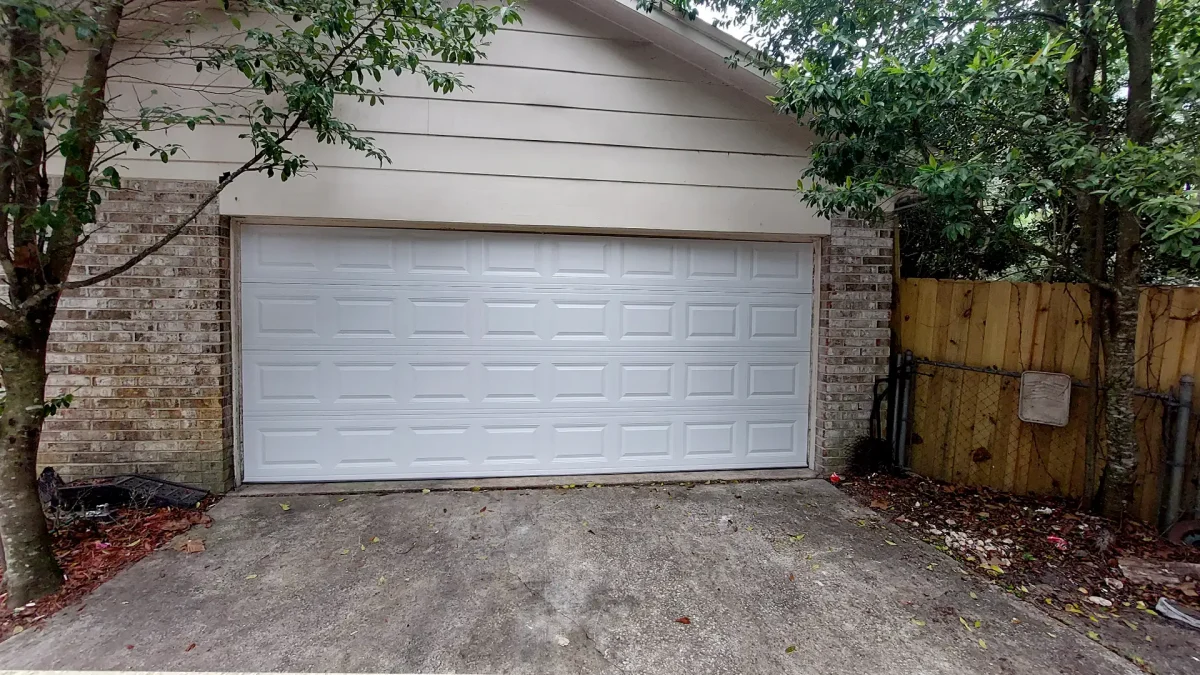
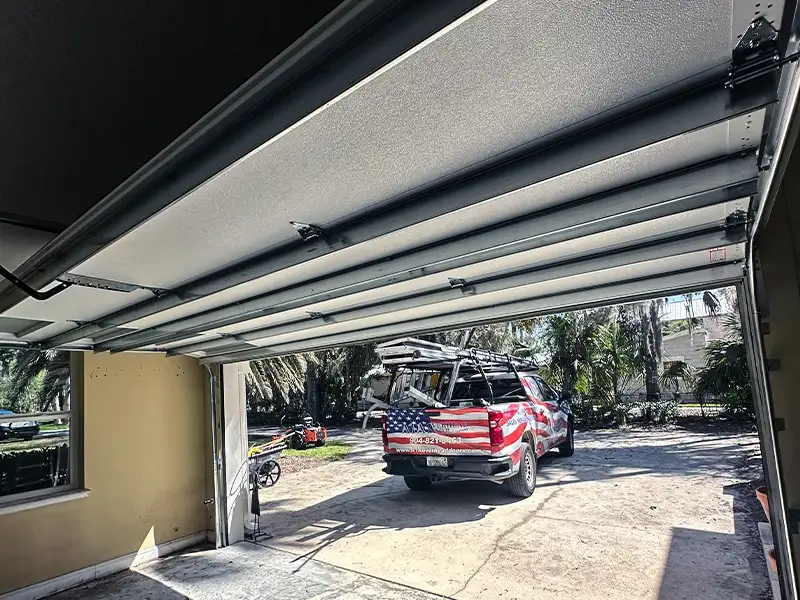
You press the wall button on a hot Jacksonville morning. The opener whirs above you, but the door stays planted on the floor and your car is trapped inside.
A1A Overhead Door Company handles this exact problem across Jacksonville and the surrounding counties. We are a family-owned, non-franchised company based at 1520 Emma Ln in Neptune Beach, Florida, and we have been incorporated since 2000.
Here is the upfront answer: a running motor does not prove the opener is doing its job. The sound tells you electricity reached at least part of the unit, but the failure may be in the connection to the door, the drive system, the door itself, or the opener controls.
The search phrase “garage door won’t open but the motor runs” describes a symptom, not a diagnosis. These seven inspection checks can narrow it down, but they are not permission to take apart a spring system, opener motor, or logic board.
Know When Not to Troubleshoot
Look at the closed door from inside the garage before touching anything. If the door is crooked, a cable is loose or off a drum, a spring has a visible gap, a roller has left the track, or a section is folding, do not press the button again.
No. Stop using the door.
Do not pull the emergency release when a door is raised, crooked, or unsupported. A disconnected door can fall if a spring or cable is no longer carrying its share of the load.
Genie warns against operating a jammed door or one with a broken spring. DASMA also says high-tension spring systems and worn cables should be handled by trained technicians.If you see damage, skip the checks and arrange garage door repair in Jacksonville.
1. Check Whether the Trolley or Carriage Is Disconnected
The opener motor moves a trolley or carriage along the rail. That moving piece connects to the door through a metal arm. Pulling the red emergency-release cord separates the door from the opener so the door can be operated manually during a power outage or service situation.
If someone pulled the cord recently, the motor may run and the trolley may travel without moving the door. From the floor, with the door fully closed, look up at the rail and watch whether the moving trolley is actually connected to the door arm.
Stay on the floor, keep fingers away, and do not repeatedly cycle the opener.
Reconnection steps differ by design. Check the owner’s manual for the exact Genie or LiftMaster model rather than forcing two parts together.
If the door reconnects but releases again, stop. A worn trolley, damaged release mechanism, or door resistance needs more than a reset.
2. Make Sure the Manual Lock Is Not Engaged
Some garage doors have a center slide lock, side lock bar, or exterior keyed lock. If that lock is engaged while an automatic opener tries to lift the door, the motor may run, hum, or strain against a door that cannot move.
With the door fully closed and the opener idle, inspect the inside face of the door. Confirm that no lock bar extends into either vertical track and that no padlock or security device is holding the door down.
Do not keep pressing the opener to “power through” a lock. That can damage the top section, opener arm, trolley, rail, or internal drive parts.
If a lock was the cause, disable it according to the door and opener instructions so it cannot be engaged accidentally. Genie calls for garage-door locks to be removed or disabled in the open position when an opener is installed.[3]
3. Look for a Broken Spring or Cable Problem
The opener is not supposed to deadlift the full weight of the door. The spring system counterbalances that weight so a correctly matched opener can guide the door through its travel.
A torsion spring above the door may show a clear gap in the coil when it breaks. An extension spring along a horizontal track may be stretched, separated, or hanging abnormally. A lift cable may be slack, frayed, tangled near a drum, or missing tension on one side.
If you see any of those conditions, the answer is not a stronger opener. DASMA states that a door requiring two hands to lift is probably out of balance and that openers are designed for properly balanced doors.[2]
No. Stop using the door.
Do not loosen a set screw, touch a cable drum, adjust a bottom bracket, wind a spring, or cut a cable. Spring-loaded components can move with severe force, and DASMA specifically identifies bottom brackets and spring-connected cables as high-tension parts for trained technicians.[1]
Our garage door spring repair service covers torsion and extension spring problems. A technician should identify the spring setup, cable condition, and related damage.
4. Test the Door’s Movement Only If It Looks Safe
This check is only for a fully closed door that is straight, supported, and visibly intact. If you saw a spring gap, loose cable, crooked section, damaged track, or heavy-door warning sign, do not disconnect it.
Switch off or unplug the opener only if the plug is safely reachable without climbing over the door or working near exposed wiring. With the door fully closed, use the emergency release as described in the owner’s manual, then lift using the proper handle.
A healthy, balanced door should move smoothly without binding. It should not shoot upward, slam down, become extremely heavy, or jam at one point. DASMA says awkward manual operation can indicate an out-of-balance spring system and should be repaired by a trained professional.[1]
If the door is crooked or heavy, no. Stop using the door. Keep everyone clear and call for service..
If the door moves smoothly by hand, the problem is more likely in the opener connection, travel system, or internal drive. Reconnect only according to the opener manual and do not operate the unit if the rail, arm, or trolley looks damaged.
5. Watch What Moves Along the Opener Rail
From the floor and at a safe distance, make one brief observation while another adult presses the wall control. The motor sound alone is vague; what moves, and what does not, narrows the diagnosis.
If the trolley travels but the door does not, suspect a disconnected or damaged trolley connection. If the chain or belt moves but the trolley does not, the carriage may be stripped or broken. If the motor runs while neither the chain, belt, screw, nor trolley moves, an internal gear, sprocket, coupler, or drive component may have failed.
Stop after one short test. Repeated operation can cause more damage or overheat a struggling opener.
Do not remove the opener cover. Internal components can include stored electrical energy, sharp moving parts, and wiring that should not be treated as a homeowner repair. Logic-board diagnosis and electrical work are not DIY work.
A1A services Genie and LiftMaster opener systems. Our garage door opener repair and installation page explains the opener types we handle throughout the Jacksonville area.
6. Listen for a Hum, Grind, Click, or Normal Travel Sound
The exact sound matters. A normal-length motor run with no door movement often points toward a lost mechanical connection. A short hum followed by a stop can indicate binding, a stalled motor, or a door the opener cannot lift.
Grinding or rattling suggests that continuing to run the unit may cause more damage. A click with little or no motor sound may involve a control, relay, capacitor, or power issue, but sound alone is not a reliable parts diagnosis.
Note how long the sound lasts, whether the light flashes, and the brand and model number if readable from the floor.
Do not probe terminals, bypass safety devices, replace capacitors, splice wires, or open the logic-board compartment. Electrical and logic-board work should be diagnosed by a technician using the correct documentation for that model.
Stop if you smell burned plastic or see smoke, arcing, melted insulation, or heat discoloration. Disconnect power only if safely reachable, keep the opener off, and have it inspected.
7. Check the Travel Path and Door Sections for Binding
A motor may run while the door stays down because the door or hardware is physically bound. Look from the floor for an object in the track, a bent track, a shifted roller, a damaged hinge, or a top section pulled inward around the opener bracket.
Do not hammer the track, force a roller back in, or loosen track brackets while the door is under load. Do not put hands between sections. DASMA advises using proper handles or gripping points and keeping fingers out of section joints during manual operation.[1]
A dented panel is not always cosmetic. A bowed section or torn opener bracket can bind the door.
A technician can determine whether hardware adjustment, reinforcement, garage door panel replacement, or a larger repair is the honest answer. We work with doors from C.H.I. and Amarr, but panel availability, design, age, color, and damage location all affect whether replacement is practical.
What This Repair May Cost
There is no responsible one-price range for “the motor runs but the door won’t open.” The same symptom can be a disconnected carriage, a broken trolley, an internal opener failure, a damaged top section, a broken spring, or a cable problem.
The quote depends on the failed component, opener model, door weight, spring configuration, parts availability, panel match, diagnosis, and related damage.
We are not going to publish a broad national number and pretend it predicts your repair. The useful comparison is the written scope: what failed, what caused it, which parts are being replaced, and whether the door is safe and balanced after the work.
Sometimes repair makes sense. An older opener with several worn components may not be worth chasing, and we will say so.
FAQ: Garage Door Motor Runs But Door Won’t Open
Why does my garage door won’t open but the motor runs ?
The sound of the motor confirms the unit is receiving power, but a mechanical connection has failed. The most common causes include:
- The emergency release cord was pulled, disconnecting the trolley from the door arm.
- A manual slide lock or side lock bar is actively engaged.
- A torsion or extension spring has broken, leaving the door too heavy to lift.
- Internal drive gears, sprockets, or couplers inside the opener are stripped.
What should I do if my garage door opener is humming or grinding?
A short hum followed by a stop usually indicates the door is physically bound or too heavy for the opener to lift. A grinding or rattling sound suggests stripped internal gears or a broken carriage. Stop pressing the wall control immediately, as repeated operation can overheat the motor or cause further damage to the drive system.
Can I manually open my garage door if the spring is broken?
No. Stop using the door and keep everyone away from the opening. Springs counterbalance the full weight of the garage door. If a spring is broken, pulling the emergency release removes the opener’s support, which can cause the door to fall heavily. High-tension spring systems must be replaced by trained technicians.
How do I check if my garage door is locked?
With the door fully closed and the opener turned off, inspect the inside face of the door panels. Look for a center slide lock, a side lock bar extending into the vertical tracks, or an exterior keyed padlock. If a lock is engaged, disable it completely before attempting to run the automatic opener again to avoid damaging the top door section or the opener arm.
Why is the opener trolley moving on the rail, but the door stays on the floor?
If the trolley travels back and forth along the rail but the door does not move, the door has been disconnected from the automatic opener. This usually happens when the red emergency-release cord is pulled. Check your specific Genie or LiftMaster owner’s manual for instructions on how to properly reconnect the trolley to the door arm.
How much does it cost to fix a garage door that won’t open?
There is no single flat rate because the same symptom can stem from entirely different mechanical failures. Repairing a disconnected carriage is a minor fix, while replacing stripped internal gears, broken high-tension springs, or damaged C.H.I. or Amarr panels requires specific parts and labor. A precise quote depends on the failed component, door weight, and necessary replacement parts.
When to Call A1A Overhead Door Company
Call when the trolley will not reconnect, the opener grinds or hums without moving the drive, the door binds, or the cause remains unclear after the safe visual checks. Call immediately if you see a broken spring, loose cable, crooked door, damaged top section, or a door that feels heavy.
A1A Overhead Door Company serves Jacksonville and nearby communities across Duval, Nassau, Clay, and St. Johns counties in Florida, plus Camden County, Georgia. For local service details, visit our Jacksonville garage door service page.
Our regular hours are Monday through Saturday, 7 AM to 8 PM. We are closed Sunday.
Call 904-821-8463 or contact A1A Overhead Door Company to schedule an inspection. “When honesty, integrity, and the customer still count.”